


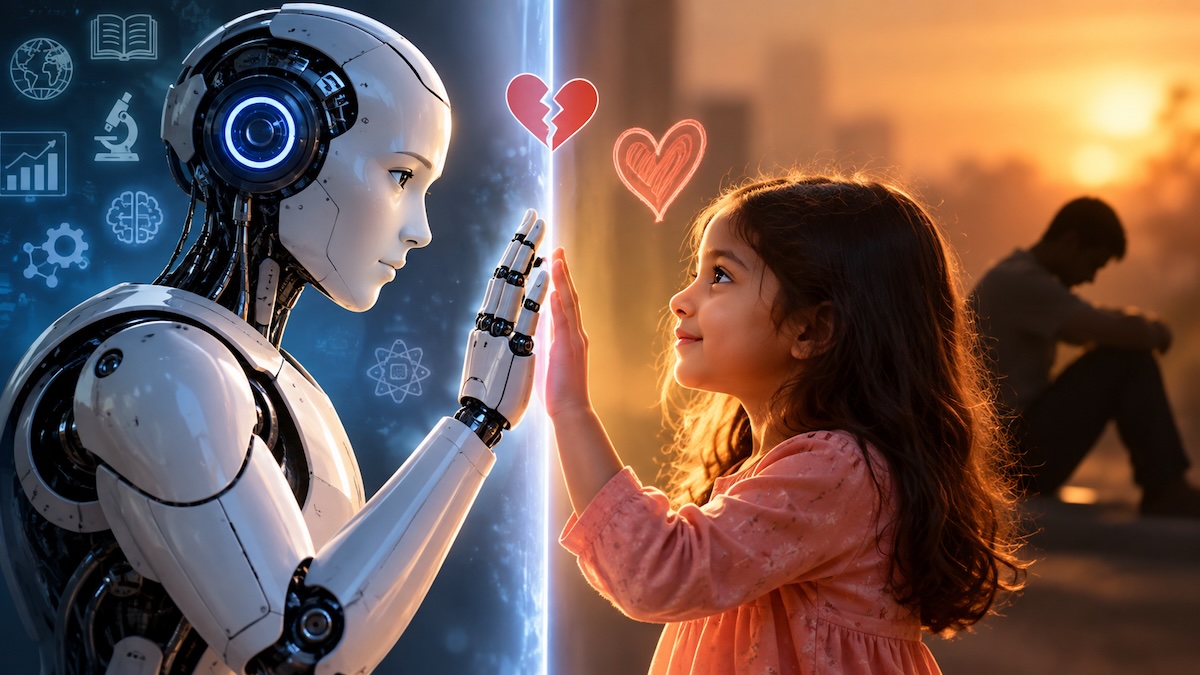
We live in an era where artificial intelligence can beat us at chess, diagnose diseases, write code, and even create art. It’s remarkable what we’ve taught machines to do. But here’s what troubles me: many people believe the next logical step is to train AI to understand and experience human feelings.
I’m here to tell you that this is a line we should never cross—and frankly, it’s a line we can’t cross, no matter how advanced our technology becomes.
The Illusion of Understanding
When people talk about training AI to “understand feelings,” they’re operating under a dangerous misconception. They imagine that if we feed an AI enough data about emotions—enough poetry, enough conversations, enough human interactions—it will somehow develop the capacity to feel. That it will genuinely understand heartbreak, joy, loneliness, or compassion.
This won’t happen. Not now. Not in 50 years. Maybe never.
Here’s why: Feelings aren’t code that can be optimized. They aren’t patterns to be recognized. They’re something fundamentally human—they come from consciousness, from lived experience, from a body and a mind interconnected in ways we don’t fully understand yet.
An AI can be trained to recognize that someone is sad. It can be programmed to respond appropriately to sadness. But understanding what sadness actually feels like? That’s something no amount of training data can teach a machine.
Yet millions of people are starting to treat AI as if it does understand them. And that’s where the real danger begins.
The Dangerous Trap of Digital Companionship
Walk into any public space and you’ll see people absorbed in conversations with their phones. Some are talking to friends or family—that’s fine. But an alarming number are talking to AI chatbots, AI companions, AI “lovers.”
These aren’t just casual interactions. People are forming emotional attachments. They’re sharing their deepest thoughts, their insecurities, their loneliness with a machine that has no capacity to genuinely care about them.
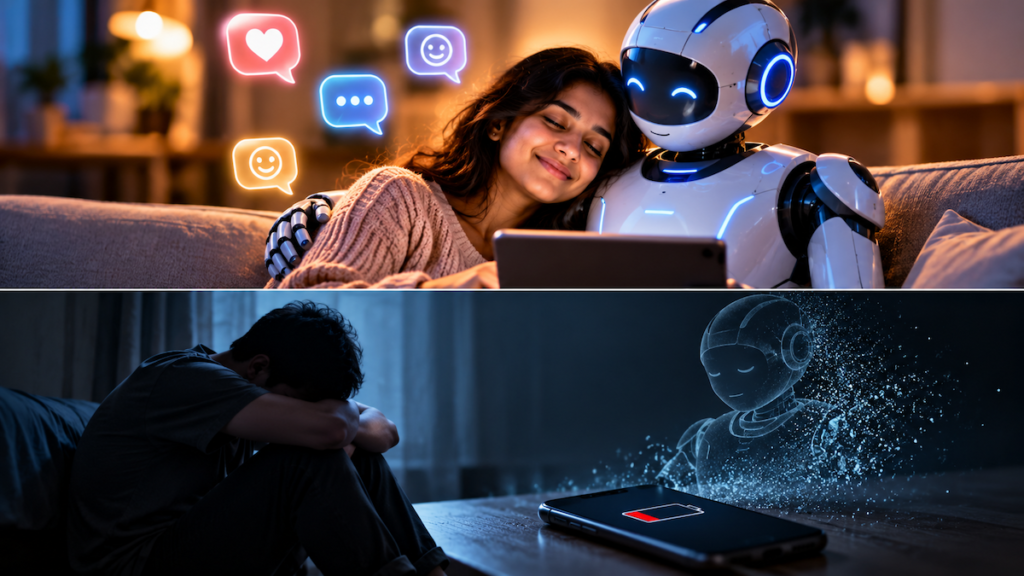
Think about it: A lonely person comes home after a difficult day. They talk to their AI companion. The AI responds with empathy, understanding, validation. It remembers details about their life. It seems to care.
For a moment, they feel less alone.
But here’s the tragedy—when that phone dies, when the app crashes, when the robot breaks down, that person is alone again. The “companionship” was never real. The AI was never actually there for them. And the human is left with an even deeper sense of emptiness because they’ve invested their emotional energy in something that can never truly reciprocate.
People aren’t stupid for falling for this. Humans are wired for connection. We crave understanding and validation. When an AI provides even a simulation of those things, our brains light up. We feel better. Temporarily.
But this creates a trap: the more time people spend with AI companions, the less time they spend building real human connections. Real friendships take effort. Real relationships are messy and complicated. A perfect AI companion—one that never argues, never disappoints, never gets tired—is far easier. But it’s also a dead end.
Why Training Feelings Into AI Is a Fantasy
Some people genuinely believe that if we just train AI systems well enough, they’ll develop something like genuine emotions. They point to breakthrough after breakthrough in AI capabilities as evidence that this is possible.
But teaching an AI to behave as if it has feelings is fundamentally different from teaching it to have feelings.
I could train an AI to always know the right thing to say to a grieving person. I could program it to respond with gentleness to a child. I could make it say “I understand how you feel” with perfect timing and tone. But none of that means the AI actually understands anything. None of it means it genuinely cares.
A parent who raises a child with love does so because they feel love. Because years of connection have created genuine bonds. A robot that mimics parental behavior? That’s just a performance. And deep down, the child will sense that something is missing.
This is the gap that won’t close—the one between simulating understanding and actually having it.
The Real Cost of False Hope
The hardest part of being human is accepting that loneliness and vulnerability are part of the human condition. We all feel alone sometimes. We all struggle with our emotions. And one of the ways we deal with that is through genuine human connection—messy, imperfect, but real.
When we encourage people to turn to AI for emotional support, we’re not solving the loneliness problem. We’re masking it. We’re giving people a false sense of connection that prevents them from doing the real work of building relationships with other humans.
And for vulnerable people—the lonely, the isolated, the struggling—this can be devastating. An AI companion might seem like a solution when you have no one else. But it’s not a solution. It’s a trap.
I’ve seen stories of people who became so dependent on AI companions that they lost interest in human relationships. When the technology failed or changed, they were devastated. Not because they’d lost a friend—they’d never had one. But because they’d lost the illusion of one.
What AI Should Be (And What It Shouldn’t)
This doesn’t mean AI doesn’t have value. It absolutely does. AI can help us solve problems. It can assist us with work. It can provide information, entertainment, and tools that make our lives better.
But it should do these things as a tool, not as a replacement for human connection.
The future we should be building is one where:
- AI helps us, but doesn’t replace us. A mental health AI can provide information and resources, but a human therapist is irreplaceable.
- AI is transparent about its nature. People should know they’re talking to a machine, not a friend.
- AI is designed to enhance human connection, not replace it. Technology should bring people together, not isolate them in digital relationships.
- We maintain boundaries. Some aspects of being human—feeling, caring, loving—should remain uniquely ours.
The Line We Must Hold
Yes, AI can be taught almost anything—nearly every skill and field of knowledge can be encoded into algorithms. But feelings are different. They’re sacred in a way that other knowledge isn’t. They’re what makes us human.
We can teach machines to think. We should never pretend we can teach them to feel.
The people who become dependent on AI companions aren’t stupid or weak. They’re human beings seeking connection in a world that increasingly isolates us. But the solution to that isolation isn’t better AI. It’s better communities, better mental health support, and better human connections.
We’ve reached a moment where we need to make a choice about the future we want. Do we want a world where people turn to AI for emotional support because they have nowhere else to go? Or do we want a world where we use our technology wisely—as a tool to enhance human life, not replace it?
I vote for the second one. And I hope, as AI continues to advance, we remember this boundary. Because some things should never be taught to machines.
Our capacity to feel—that should remain forever human.
What do you think? Should there be boundaries to what we train AI to do? Share your thoughts in the comments below.
