


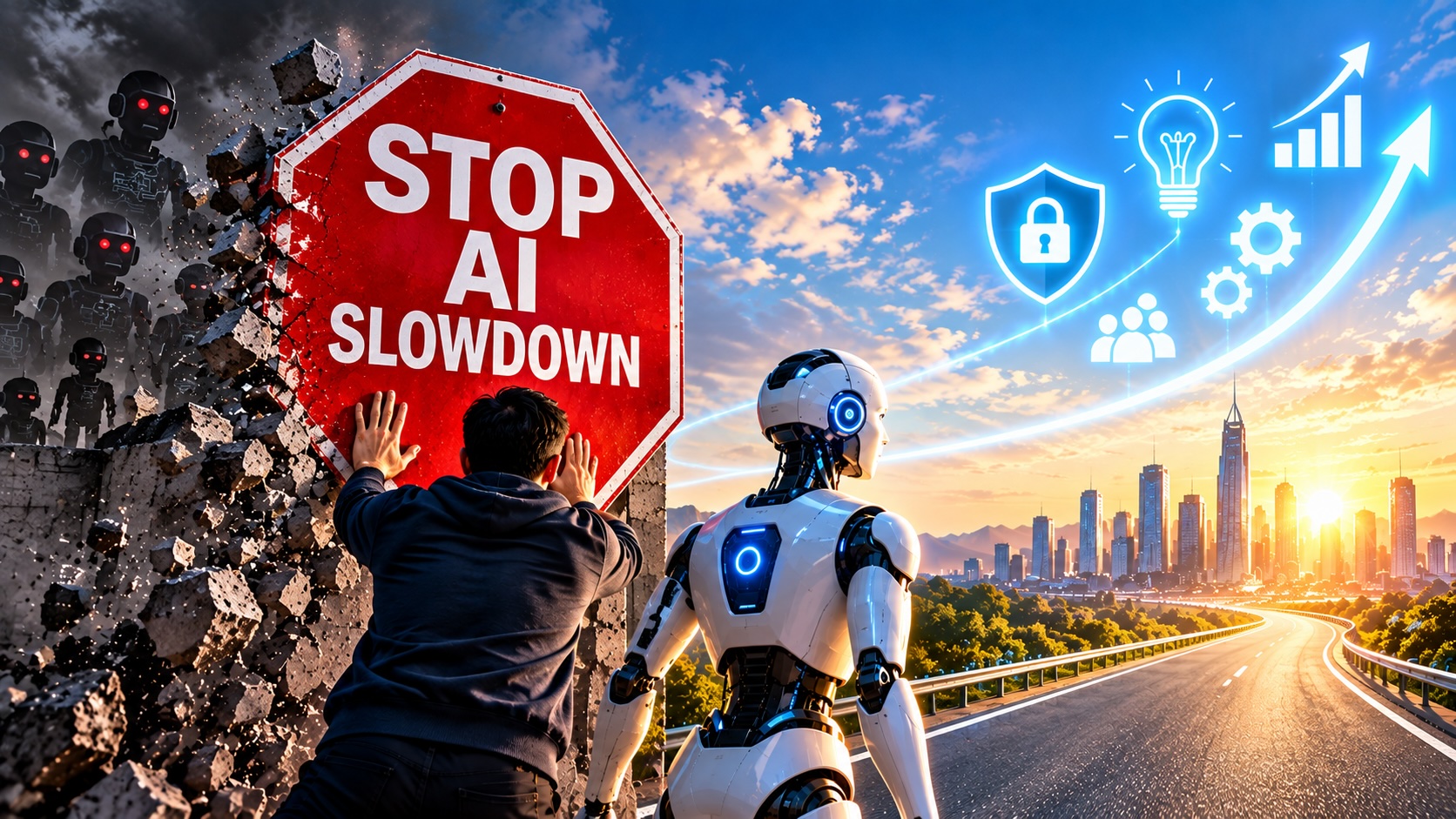
Artificial intelligence has reached a point where the world is no longer debating whether AI will change our future. It already is. The debate now is whether we should introduce an AI Slowdown because increasingly powerful AI systems could become dangerous. While I understand the concerns behind calls for caution, I personally don’t believe stopping or broadly slowing AI development is the right answer. In my opinion, AI development has already started, and instead of trying to put the technology back in the box, we should make AI safety, cybersecurity and defensive AI develop even faster.
Why Is There an AI Slowdown Debate?
The concerns surrounding advanced AI are not imaginary. AI systems are becoming increasingly capable of writing software, analyzing huge amounts of information, operating tools, finding vulnerabilities and performing tasks that previously required significant human expertise.
In recent weeks, some of the biggest names in the technology industry have supported calls to slow the development of increasingly powerful AI systems. Elon Musk has backed Anthropic CEO Dario Amodei’s call to “pace the frontier,” while OpenAI CEO Sam Altman has also expressed support for slowing development when safety cannot keep up.
As these systems become more autonomous, it is reasonable to ask what could happen if an AI system behaves unexpectedly or if someone deliberately uses it for harmful purposes.
This is why the discussion around an AI Slowdown has gained so much attention. Some people believe that AI companies should reduce the speed at which increasingly capable models are developed until better safety systems, regulations and testing procedures are available.
I agree with the need for better safety. Where I disagree is with the idea that slowing down AI development across the board is necessarily the safest solution.
There is an important difference between developing AI responsibly and stopping AI development.
I strongly support the first. I am much more skeptical of the second.
AI Development Has Already Started
Let’s consider a simple question: should AI development have started at all?
Perhaps, if we could go back several decades, we could argue that humanity should have approached artificial intelligence differently. Maybe we should have established stronger safety frameworks before developing increasingly capable systems.
But we cannot go back.
AI development has already started, and the technology is now being developed by companies, universities, independent researchers, governments and individual developers around the world. Open-source models are available, private research continues and AI is increasingly integrated into software, cybersecurity, science, business and everyday applications.
That means the question is no longer:
“Should humanity develop AI?”
The more realistic question is:
“How do we make sure humanity remains safe while AI continues to develop?”
Those are completely different questions.
Why an AI Slowdown Could Create a Different Risk
This is where I have a major concern about a broad AI Slowdown.
Imagine that the organizations investing heavily in AI safety decide to stop developing increasingly capable systems until every possible risk has been completely understood.
That sounds responsible.
But what happens to everyone else?
Will every company stop?
Will every independent researcher stop?
Will every laboratory stop?
Will every developer with access to powerful computing resources stop?
Probably not.
AI development is already too widespread for one organization or even a group of organizations to simply turn off the technology.
There is a possibility that the organizations taking safety seriously could slow down while less responsible actors continue developing increasingly capable systems.
If that happens, the people who understand AI safety best could potentially lose their technological advantage.
I don’t think that is necessarily a safer situation.
The Dangerous AI May Come From Somewhere We Don’t Expect
One of my biggest concerns is that the most dangerous AI system of the future may not come from an organization that publicly talks about AI safety.
It could be developed privately by someone who has no interest in transparency. It could be created by a criminal organization, a secret research group or another actor whose objectives are very different from those of responsible AI developers.
If responsible AI development slows significantly while another actor continues developing powerful systems without meaningful safety controls, what happens?
We could eventually find ourselves trying to defend against technology that we don’t fully understand.
That is why I believe technological capability itself can also be part of our defense.
You cannot effectively defend against technology that you don’t understand.
We need to understand how advanced AI works, what it can do, how it can fail and how it could potentially be misused. That understanding comes from research, testing and development.
AI Safety Should Develop Faster Than AI Capability
This is the central point of my argument.
I am not saying that AI companies should simply develop increasingly powerful systems and ignore the consequences. Quite the opposite.
If AI capability increases, AI safety capability should increase at an even faster rate.
Every significant advancement in AI should be accompanied by stronger testing, monitoring, security and containment mechanisms.
A more capable AI system should have better safeguards.
A more autonomous AI system should have stronger controls.
A model with powerful cybersecurity capabilities should undergo more rigorous testing.
A system capable of taking actions in the real world should have appropriate human oversight.
Instead of thinking about AI safety as something that comes after AI development, we should treat it as an integral part of AI development.
We Need More Defensive AI
A huge amount of attention is currently focused on what AI can do for ordinary users.
AI can write emails, generate images, create software, summarize documents, prepare presentations, analyze data and automate repetitive tasks. These applications are useful and will continue to grow.
But I believe we should also be putting enormous resources into defensive AI.
Imagine AI systems specifically designed to identify cyberattacks, detect malware, monitor networks, discover software vulnerabilities and recognize unusual behavior.
Imagine systems continuously testing critical software for weaknesses and immediately alerting security teams when something suspicious is detected.
AI could also help cybersecurity researchers analyze enormous amounts of information that humans simply cannot examine manually.
Instead of waiting for a security analyst to identify a new attack pattern after hours of investigation, defensive AI could potentially identify unusual behavior much faster.
The same technology that makes AI powerful for attackers could potentially make it extremely powerful for defenders.
This is one area where I believe AI development should accelerate dramatically.
The Best Defense Against Bad AI May Be Better AI
There is an interesting paradox here.
If a malicious actor eventually develops an extremely capable AI system, our best defense may also be an AI system.
Imagine a defensive AI monitoring millions of events every second. A human security team may need significant time to examine logs and identify a sophisticated attack. A capable defensive AI system could potentially recognize unusual patterns much faster.
Another AI system could analyze the attack. A separate system could investigate the vulnerability. Another could test a potential solution, while another could check whether the same weakness exists elsewhere.
Humans would still make important decisions, particularly when the consequences are serious. But AI could dramatically increase the speed at which humans understand and respond to threats.
This could become one of the most important areas of AI research.
AI Could Help Us Solve AI Safety
There is another reason I don’t want AI development to stop.
AI itself could become one of our most important tools for understanding AI.
Human researchers have limitations. There are only so many experts who can manually analyze increasingly complex AI systems.
AI could help us overcome some of those limitations.
One AI system could test another AI system in a controlled environment. Another could search for vulnerabilities. Another could analyze unexpected behavior. Another could act as a red-team system and deliberately attempt to bypass safety mechanisms.
This creates an interesting possibility where AI becomes part of its own safety infrastructure.
Instead of relying entirely on humans to discover every potential weakness in advanced AI systems, we could have AI systems continuously testing, monitoring and challenging one another.
In other words, AI could become the security researcher for AI.
AI Slowdown vs. Responsible AI Development
This is where I think the discussion needs more nuance.
I completely support AI safety. I support extensive testing, independent evaluations, security audits, monitoring and controlled deployment.
I support restrictions around dangerous applications. I support strong safeguards around AI systems that can interact with critical infrastructure or perform high-impact actions.
But there is a difference between saying “AI development should be safe” and saying “AI development should stop.”
If a particular AI system demonstrates a dangerous capability that researchers don’t understand, deployment should absolutely be reconsidered.
If testing reveals a serious security problem, development should pause long enough to understand and fix it.
If an AI system behaves unexpectedly, researchers should investigate before giving it more autonomy.
That is not abandoning AI development.
That is responsible engineering.
We Don’t Stop Aviation Because Airplanes Can Crash
Consider aviation.
Airplanes can crash, and aviation accidents can have catastrophic consequences. Yet humanity didn’t decide that the answer was to stop building airplanes.
Instead, we developed better navigation systems, better engines, stronger aircraft, air traffic control, weather monitoring, emergency procedures and increasingly sophisticated safety systems.
When something goes wrong, engineers investigate what happened and use that information to improve future aircraft.
AI needs a similar philosophy.
The answer to a dangerous technology isn’t necessarily to stop improving the technology. Sometimes the answer is to develop better technology that makes the system safer.
We shouldn’t simply make AI more powerful.
We should make the systems protecting us more powerful as well.
The AI Race Should Also Become a Safety Race
Perhaps we are looking at the problem from the wrong direction.
Instead of focusing only on whether there should be an AI Slowdown, why can’t we create an equally aggressive race toward AI safety?
Companies and researchers should compete to build better AI cybersecurity systems, better model evaluation tools, better monitoring systems, better red-team systems and better methods for detecting dangerous behavior.
We should encourage research into AI containment, model security, autonomous threat detection and systems capable of identifying when another AI system is behaving unexpectedly.
Imagine an ecosystem where every major AI capability is accompanied by increasingly sophisticated safety technology.
When AI becomes more capable, safety systems become more capable.
When AI becomes more autonomous, monitoring becomes stronger.
When AI gains access to more tools, security controls become stricter.
When AI becomes capable of performing potentially dangerous tasks, testing becomes more rigorous.
That approach makes much more sense to me than simply asking everyone to slow down.
We Should Not Give Up Our Ability to Understand AI
There is another practical reason to continue AI research.
If we deliberately stop learning about increasingly capable AI systems, we could eventually lose the ability to understand what advanced AI is capable of.
You cannot create effective safety rules for technology you don’t understand.
You cannot defend effectively against technology you cannot test.
And you cannot reliably evaluate an advanced AI system if you don’t have the expertise and technology necessary to understand its capabilities.
This is why continued research is important even when the results make us uncomfortable.
Sometimes the safest way to understand a dangerous technology is to study it more deeply, not to stop studying it.
But There Must Be Limits
None of this means I support an uncontrolled AI race.
Absolutely not.
There are areas where we should be extremely careful.
AI systems controlling critical infrastructure should have strict safeguards. Systems capable of performing dangerous cyber operations should be developed and tested in controlled environments. AI systems handling sensitive information need strong privacy protections.
Highly autonomous systems should have meaningful human oversight, particularly when their actions could cause serious harm.
And when testing reveals a capability that creates unacceptable risk, deployment should stop until the problem is properly addressed.
My argument isn’t “build everything as quickly as possible and worry about the consequences later.”
My argument is:
Continue advancing AI capability, but make safety development a mandatory part of capability development.
The Future Could Become AI vs. AI
I don’t necessarily mean an AI war.
I mean that cybersecurity itself could increasingly become an environment where AI systems are used on both sides.
Attackers could use AI to search for vulnerabilities, while defenders use AI to discover those attacks. Attackers could automate phishing and social engineering, while defensive AI identifies suspicious behavior. Attackers could generate malicious software, while defensive AI analyzes and contains it.
Attackers could use autonomous agents, while defensive AI monitors and responds to those agents.
This future may be difficult to avoid.
If that is where technology is heading, I would rather have the strongest defensive technology available.
My Position: Don’t Stop AI. Build the Shield.
This is ultimately where I stand.
I don’t think humanity can realistically put AI back into the box. The technology has already spread too far across research, software development, cybersecurity, business and everyday life.
Instead of asking “How do we stop AI development?”, I think we should ask:
“How do we make sure humanity develops the technology necessary to understand, control and defend against advanced AI?”
I want more AI safety researchers, more cybersecurity AI, more independent testing, more red-team systems, more monitoring, better containment technology and better safeguards.
And yes, I also want more capable AI.
That may sound contradictory, but I don’t think it is.
If advanced AI eventually becomes a major security challenge, I would rather face that challenge with the best defensive technology we can build.
If someone develops a powerful offensive AI, I want us to have a powerful defensive AI.
If an AI discovers a new cyberattack, I want another AI to detect it.
If an AI finds a vulnerability, I want another AI to help patch it.
If an AI system behaves unexpectedly, I want safety systems capable of detecting and containing it.
And if we discover that a particular AI system is genuinely too dangerous to deploy, then stop that particular system.
But don’t stop learning.
Don’t stop researching.
Don’t stop developing the technology needed to understand what is happening.
Final Thought: Don’t Slow Down the Future — Secure It
AI could ultimately become one of humanity’s greatest inventions. It could also become one of our greatest challenges.
We don’t know exactly where this technology will take us, and that uncertainty is precisely why safety matters.
But I don’t believe fear should make us surrender our ability to develop the technology.
The safer path, in my opinion, is not to make AI development disappear. It is to make sure that our ability to understand, monitor and defend against AI develops even faster.
We should build AI, test it, challenge it, attack it in controlled environments, secure it and continuously improve it.
We shouldn’t stop AI development. We should make AI safety develop faster than AI capability.
That, in my opinion, gives us a much better chance of being prepared for whatever comes next.
